How Pressure Treated Pine Resists Cleveland’s Freeze-Thaw Ground Movement
If you need a fence that keeps a dog in the yard through a Cleveland winter, the real question is not just how pressure treated pine resists rot. It is how the whole fence handles ground that freezes, swells, and thaws over and over from November through April. That movement is what opens gaps at the bottom of fences, racks gates until the latch stops catching, and heaves posts until a determined dog finds the way out. Understanding how freeze-thaw cycles affect fence posts is essential to building a fence that will last.
This guide walks through what freeze-thaw ground movement actually does to a fence, why pressure treated pine is a strong match for those conditions, where it falls short, and what to watch for during installation so the fence you build stays tight for a dog or a toddler.
The Real Problem: How Freeze-Thaw Cycles Impact Fence Posts
Here is the pattern most homeowners never see coming. Water in the soil freezes and expands. The ground pushes upward and sideways on anything buried in it, including fence posts. Then it thaws, the soil settles, and everything shifts back, but not quite to where it started.
Repeat that cycle dozens of times in a single winter and you get posts that rise out of the ground a half inch a year, pickets that pull away from rails, and gates that sag until they drag on the walk. For most fences, this is annoying. For a fence that exists to contain a 70-pound dog or keep a three-year-old out of the street, it is a failure.
Freeze-thaw movement attacks a wood fence in three specific places:
- The post at ground level. Moisture concentrates right where the post meets the soil. The wood stays wet, freezes, and gets stressed at the exact point carrying the most load.
- The bottom of the fence line. As posts heave unevenly, the gap under the fence changes. A gap that was two inches in October can be five inches by March, which is all a small dog needs.
- The gate. A gate hangs from one post. If that post tilts even slightly, the latch misses the catch. A gate that does not latch on its own is the single most common escape route for dogs and kids.
So the material question is really a movement question. You want a fence that stays sound while the ground around it refuses to cooperate.
Why Pressure Treated Pine Resists the Wet Half of the Problem
Pressure treated pine resists rot and insect damage because preservative chemicals are forced deep into the wood under pressure, not painted on the surface. That matters in Cleveland because the destructive part of freeze-thaw is not the cold. It is the water.
Untreated wood buried at grade sits in damp soil for months. Fungi break it down from the inside, and by year five or six the post can snap at ground level even though the top still looks fine. The treatment in pressure treated pine shuts that process down where the post needs it most, below grade and at the soil line where moisture never fully dries out.
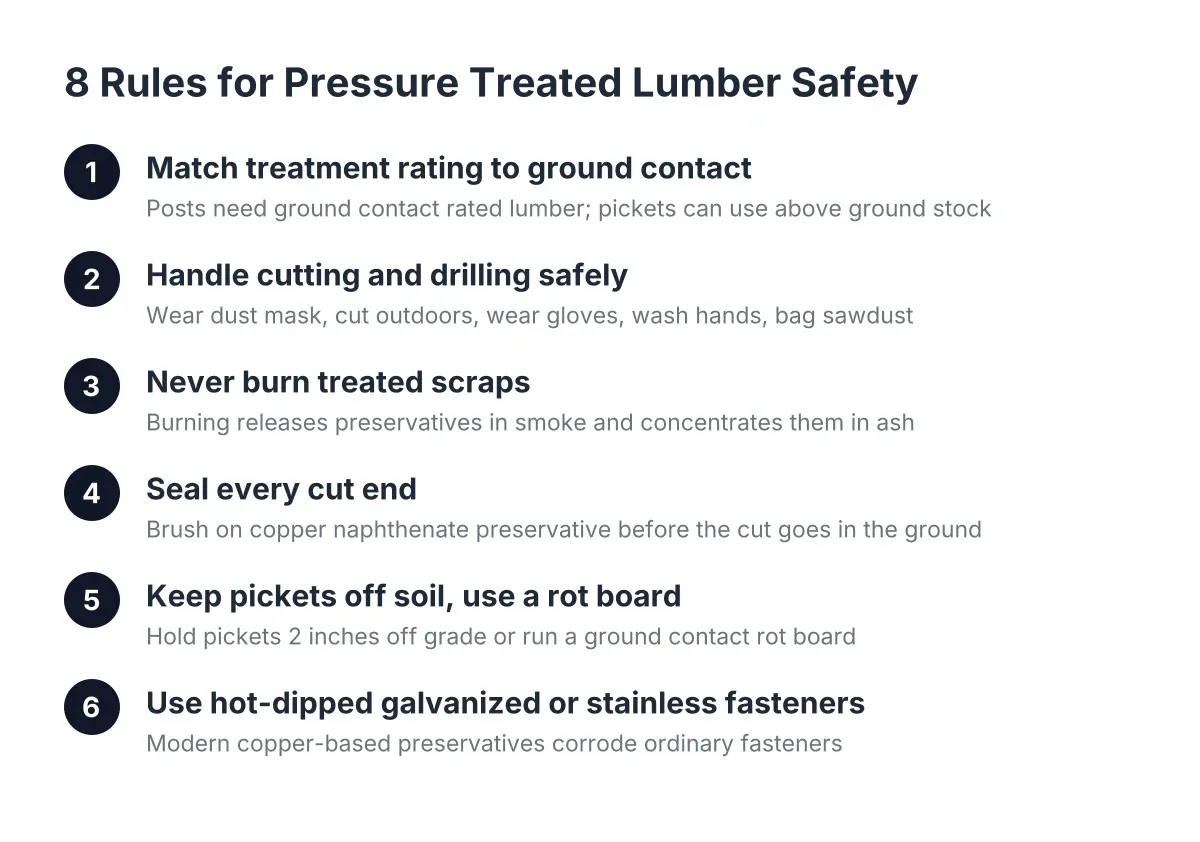
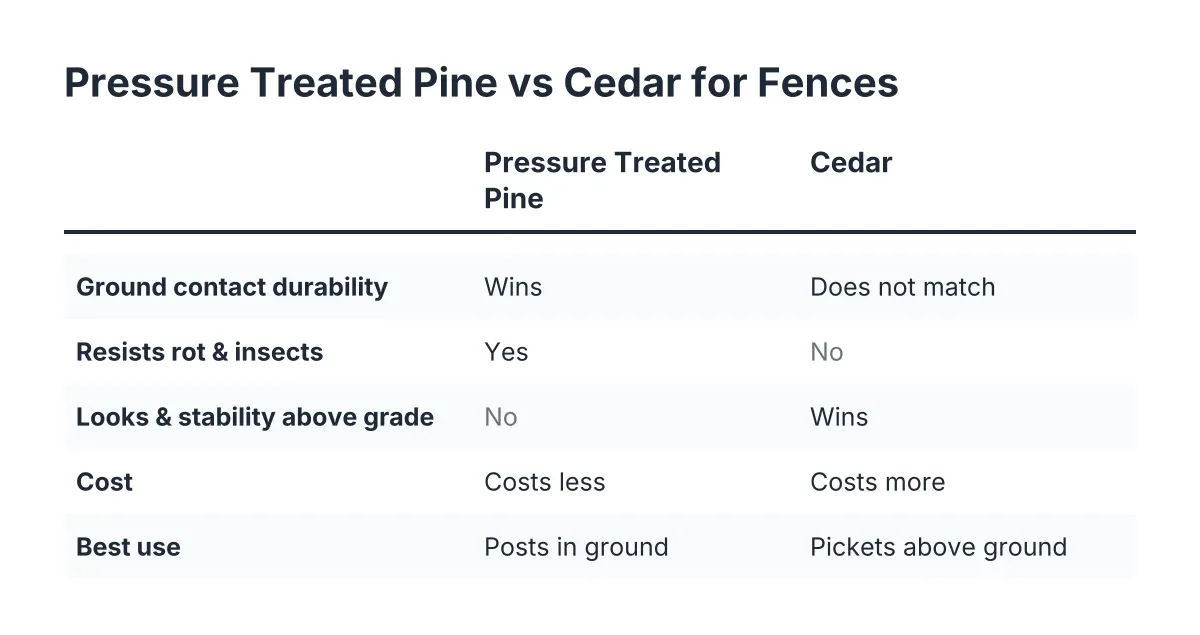
Cedar earns its reputation above ground. Its natural oils slow decay, and it holds a straight, attractive face on pickets and panels. However, cedar in ground contact does not match treated pine. That is why a common build in this climate pairs the two: pressure treated pine posts in the ground, with cedar or treated pine pickets above. Many installers also run a pressure treated pine rot board along the bottom of a cedar fence. That one sacrificial board stops the cedar pickets from wicking up moisture from pooled water and snowmelt, which protects the rest of the fence for years.
For the homeowner comparing a pressure treated pine vs cedar fence, the honest summary is this. Cedar wins on looks and stability above grade. Treated pine wins below grade and at the soil line, which is exactly where Cleveland winters do their damage. Pine also costs noticeably less, which matters when you are fencing a full backyard before a new puppy arrives.
What Pressure Treated Pine Resists, and What It Does Not
Pressure treated pine resists rot, fungal decay, and insect attack for the life of a typical fence. What it does not resist is the physics of drying wood. Understanding both sides keeps your expectations realistic.
Because the treatment process forces liquid deep into the lumber, a new pressure treated wood fence can stay wet for months after installation. As those boards dry, some will move. Expect minor checking, small surface cracks, and occasional warping, especially through the first summer. This is normal, and it is the main trade-off you accept for the lower price and the ground-contact durability.
You can reduce the movement problem before a single post goes in:
- Check the grain on posts. A board where the heart, the center of the growth rings, sits at the edge of the board is more likely to twist as it dries. Look at the end grain and favor posts with the heart near the center.
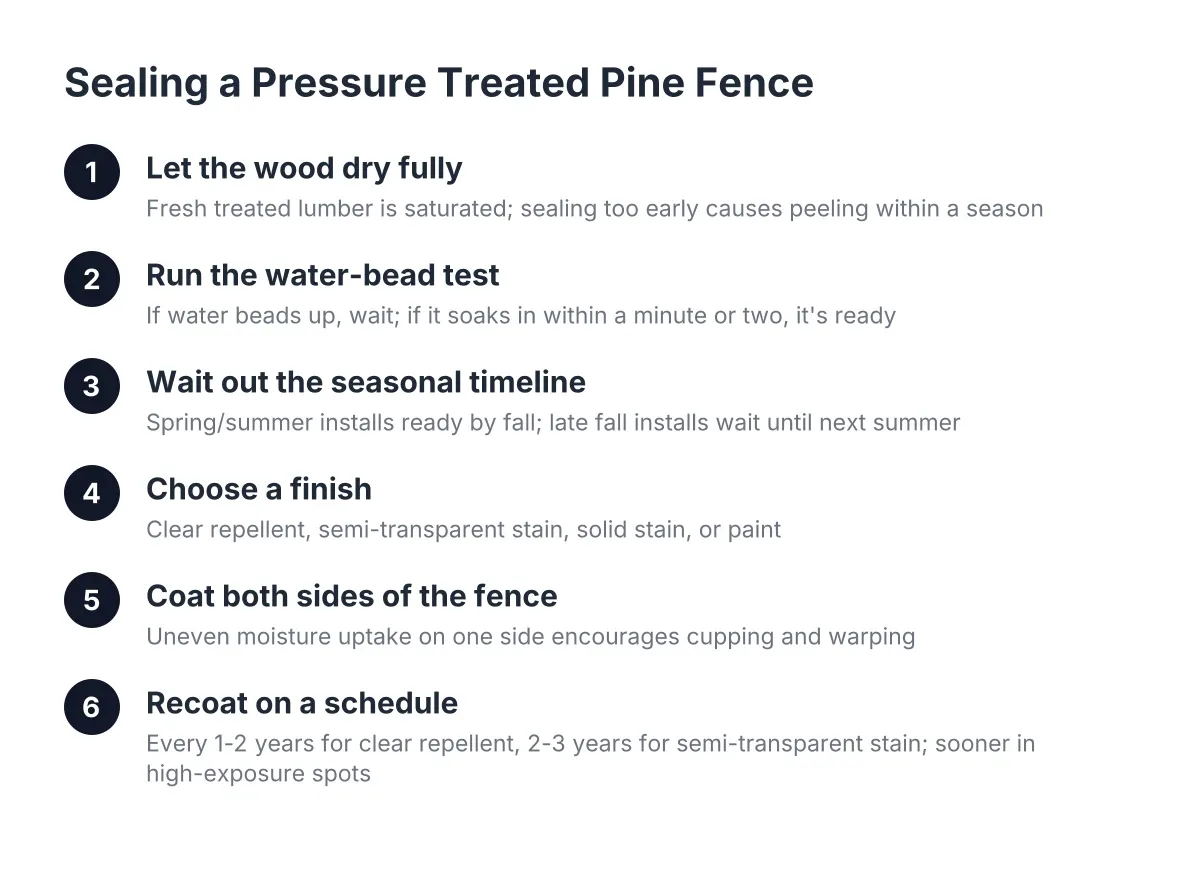
- Let the wood dry before staining. Sealing wet treated pine traps moisture inside. Wait until water no longer beads on the surface, then finish it. Oil-based stains are well suited to pressure treated pine and penetrate better than film-forming products.
- Protect the grade line. The few inches above and below the soil surface take the worst moisture exposure. A rubberized waterproof coating or a shrink sleeve wrapped around the post at that transition zone extends the structural life of the post where it matters most.
None of this is complicated. It is the difference between a fence that holds its line for 15 years and one that starts leaning in 5.
Post Setting: How Installation Protects Against Freeze-Thaw Fence Posts Issues
Material choice gets the attention, but post setting decides whether freeze-thaw movement ever becomes your problem. A pressure treated pine fence with shallow posts will heave. The same fence with posts set below the frost line, in holes with proper drainage, will hold its line winter after winter.
Three installation decisions carry most of the weight:
- Depth below frost line. When the footing sits deeper than the soil ever freezes, the expanding ground above it has far less to grab and lift. Shallow posts ride up a little each winter and never come all the way back down.
- Enough concrete, placed right. A post needs a generous collar of concrete on all sides to resist lateral movement. Thin, uneven concrete lets the post rock, and a rocking post loosens faster every season. At the same time, concrete that traps water against the wood can speed up rot instead of preventing it, so drainage at the bottom of the hole and a crowned top that sheds water away from the post both matter.
- Gate posts built heavier than line posts. The gate is the moving part, the part your dog tests every day, and the part a self-latching mechanism depends on. Gate posts deserve deeper settings and more concrete than the rest of the run, because a quarter inch of tilt at the post becomes a latch that misses.
This is also the honest place to say that post setting in Cleveland's older neighborhoods is not always a straightforward dig. Tight lot lines, buried utilities, old footings from previous fences, and property-line questions on inner-ring streets are reasons to involve a professional fence company rather than guess. A fence permit may also be required depending on your city and fence height; verify with your local building department before you set anything in concrete, because requirements vary across Greater Cleveland.
A Hypothetical Backyard: The Dog, the Gap, and the Gate
Suppose a family in a Cleveland suburb adopts a 65-pound shepherd mix in the fall. The yard has an old fence with posts set about two feet deep, no concrete on half of them. By February, three posts have heaved and tilted. The gap under the back run has grown to four inches, and the gate latch needs a hip check to close. One morning the gate blows open, and the dog is loose on a street with traffic.
In that scenario, the fix is not a patch. It is a fence replacement with posts set below frost depth, a pressure treated pine fence line with a rot board tight to grade, and a gate installation built on an oversized post with a self-closing hinge and a latch mounted high enough that a child cannot reach it. The bottom of the fence follows the ground closely, with the rot board closing the gap a digging dog or a squeezing toddler would otherwise exploit.
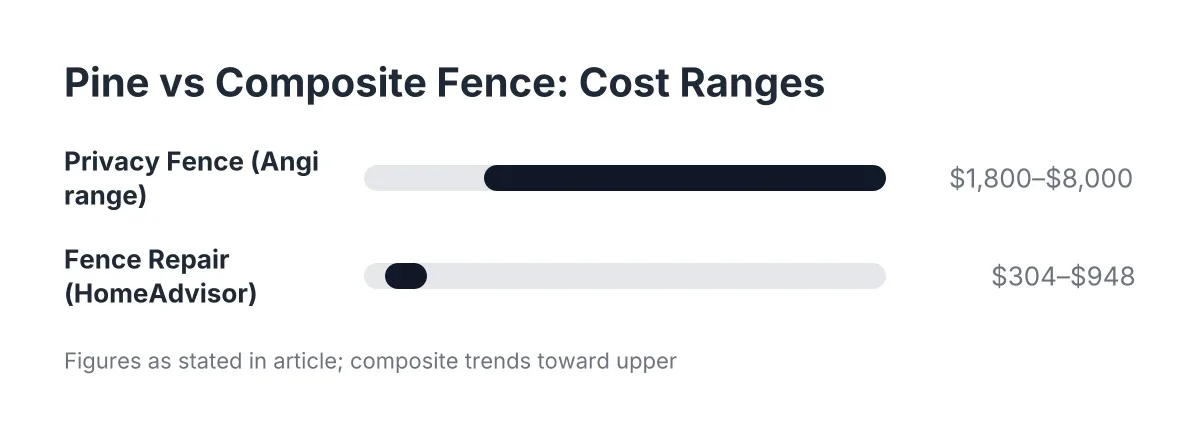
For budgeting, national figures give a starting frame. Angi reports fence installation costs an average of $3,277, with most homeowners paying between $1,860 and $4,843. For a taller privacy fence, Angi data puts the typical range at $1,800 to $8,000, averaging $4,300. NerdWallet reports professionally installed fences run $15 to $25 per linear foot on average, citing Angi data. Treated pine usually lands at the lower end of wood pricing, which is one reason it is the default choice for full-yard containment projects. Your actual number depends on linear footage, height, gate count, and site conditions, so treat these as orientation, not a quote.
It is also worth knowing when repair beats replacement. HomeAdvisor reports fence repair averages $618, with most homeowners spending between $304 and $948. If only a post or two has failed and the rest of the fence is sound, a targeted fence repair can buy years. If the posts were set shallow across the whole run, you will be repairing a different section every spring.
Pressure Treated Pine vs Cedar When Containment Is the Job
For a containment fence, the comparison shifts away from curb appeal and toward structure. Both woods can build a secure fence. The question is where each dollar does the most work for the specific problem you are solving, which is keeping a dog or a child inside the line.
Here is how the decision usually breaks down in 2026 for Cleveland yards:
- Choose pressure treated pine throughout when budget drives the project, when the dog is the priority and looks are secondary, or when you are fencing a large yard and the per-picket price difference multiplies fast. Pressure treated fencing handles ground contact, snow load against the bottom rail, and wet springs without rotting out.
- Choose cedar pickets on treated pine posts when you want the warmer look of cedar on a privacy fence but refuse to compromise on what is in the ground. Add a treated pine rot board at the bottom so the cedar never sits in snowmelt.
- Skip solid wood for the pickets entirely in some cases. A chain link fence on properly set posts contains most dogs at lower cost, and it shows you the street so you can see what your dog is reacting to. Wood wins when you also want privacy or when the dog is reactive to everything it sees.
One more practical note for pool and play-yard buyers. If your fence exists to satisfy a pool enclosure requirement or an insurance condition, the gate hardware and fence height may be dictated by local code, not preference. Confirm the specifics with your municipality's building department before ordering material, because a fence that contains the dog but fails inspection has to be modified anyway.
What to Ask Before You Build
A fence is a system: material, post depth, concrete, drainage, gate hardware, and the ground itself. Pressure treated pine resists the moisture side of Cleveland's freeze-thaw cycle better than any other wood at its price, but the installation decides whether the posts stay put. Before you commit to a fence installation, get clear answers to these questions:
- How deep will the posts be set, and is that below local frost depth?
- How much concrete goes around each post, and how is drainage handled at the bottom of the hole?
- Will the gate posts be set heavier than the line posts?
- Is there a rot board or other detail closing the gap at grade?
- Does my city require a fence permit for this height and location, and who confirms that with the building department?
- How will the fence follow the ground so no section leaves a dog-sized gap?
Any installer working in Greater Cleveland should answer those without hesitation, because they are the questions this climate forces. Get them answered up front, and the freeze-thaw cycles will test your fence, but the one you build this year will still be latching cleanly, holding its line, and keeping everyone inside it when the ground starts moving again next winter.
If you need fence installation, Cleveland Fence Installers can help.
Prefer to talk it through? Call (216) 465-0485 — a quick call is usually the fastest way to get a straight answer for your situation.