Chain Link Fence Cost in Cleveland: Material, Labor, and Climate Factors
If you are pricing a fence for the first time, chain link fence cost is probably the number you want nailed down before you call anyone. That is the right instinct. Most people get burned not by the fence itself but by what they did not know going in: what the materials should run, what labor covers, whether the city wants a fence permit, and how Cleveland's ground and winters change the math. This guide walks through all of it so you can read a quote and know whether it makes sense.
One note up front. National averages are a starting point, not a promise. Your yard, your lot lines, and your soil decide the real number. However, once you understand what drives the price, a quote stops looking like a mystery and starts looking like arithmetic.
Why Chain Link Is Usually the Budget Pick
Chain link earns its reputation as the affordable option. The materials are simpler than wood, the labor goes faster, and the fence shrugs off weather that destroys other materials. For a new homeowner staring at a blank backyard that needs to hold a dog or keep a toddler out of the street, it is often the shortest path from open yard to enclosed yard.
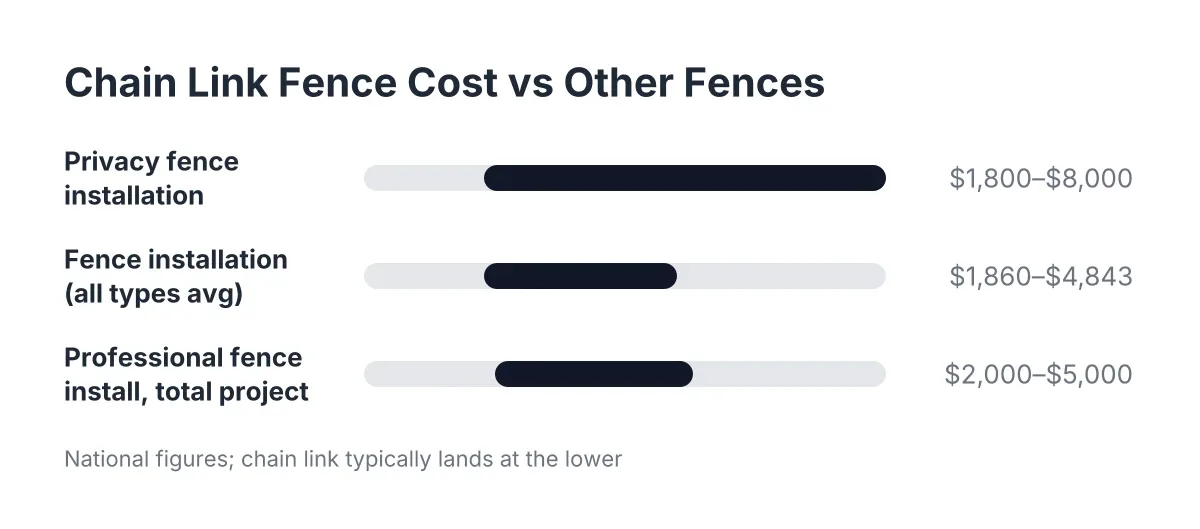
Is chain link fence the cheapest option? For most yards, yes. A galvanized chain link fence almost always comes in below a wood fence of the same length, and well below a privacy fence. Angi data shows privacy fence installation typically costs between $1,800 and $8,000, averaging $4,300. Chain link for the same footage usually lands under that range because the material costs less per foot and installs faster.
That gap matters for the comparison most buyers are weighing: chain link fence cost vs wood. Wood gives you privacy and a warmer look. Chain link gives you containment, visibility, and a lower bill. Neither answer is wrong; they solve different problems. If the job is "keep the dog in the yard," chain link does that for less money and with less maintenance over the next twenty years.
How Chain Link Fence Cost Breaks Into Materials, Labor, and Site Conditions
The cost of a chain link fence breaks into three buckets: materials, labor, and site conditions. Materials and labor are the parts every calculator covers. Site conditions are where Cleveland quotes move up or down, and we will get to those in the next section.
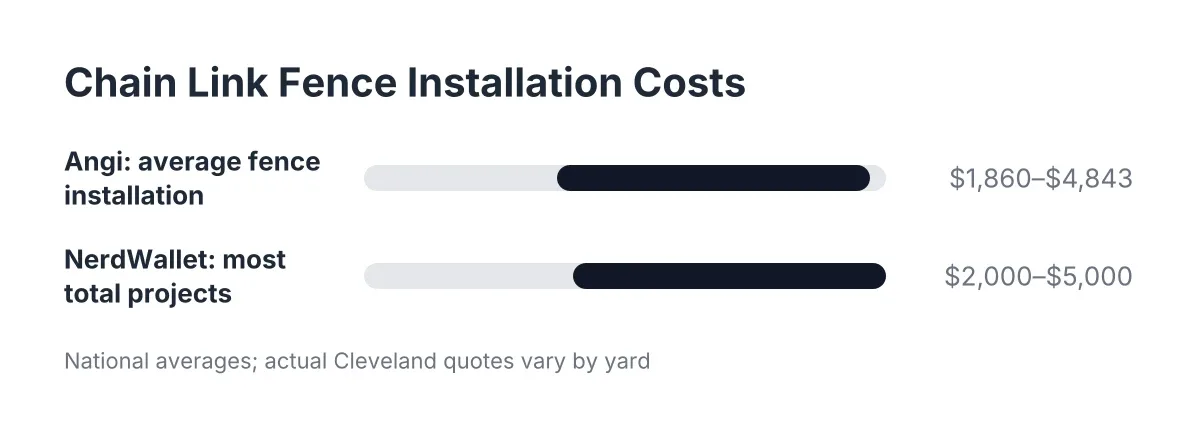
For context on the overall market, Angi reports that fence installation costs an average of $3,277, with most homeowners paying between $1,860 and $4,843. NerdWallet reports professionally installed fences cost $15 to $25 per linear foot on average, citing Angi data, with total project costs typically between $2,000 and $5,000. Chain link tends to sit at the lower end of those ranges. Those are national figures across all fence types, so treat them as a sanity check, not a quote.
Materials: more decisions than you'd expect
Chain link looks like one product from the street. It is actually a system of parts, and each one has a price lever:
- Fabric gauge. The mesh itself comes in different wire thicknesses. Lower gauge numbers mean thicker wire, more strength, and more money. A 9-gauge fabric costs more than 11-gauge but handles a jumping dog or a leaning snowbank better.
- Height. A 4-foot fence uses less fabric and shorter posts than a 6-foot fence. Height is one of the biggest per-foot price movers.
- Coating. Standard galvanized is the baseline. Black vinyl-coated chain link costs more per foot but blends into a landscaped yard and resists corrosion longer.
- Framework. Posts, top rail, and fittings vary in pipe diameter and wall thickness. Heavier pipe costs more and lasts longer. Even small parts scale with the system; fence ties that hold the fabric to the framework come in different lengths to match the pipe diameter.
- Gates. A walk gate is a line item. A double drive gate wide enough for a mower or a trailer is a bigger one. Gate installation adds hardware, extra posts, and extra concrete.
Labor: what you are actually paying for
Labor covers layout, digging, setting posts in concrete, hanging and stretching the fabric, and tying it off. Stretching is the skilled part. Chain link fabric has to be pulled tight and tied correctly, or the fence sags within a year or two. A careful crew also sets the end posts first and runs a string line between them before digging, so the fence runs straight instead of wandering with the terrain.
In addition, labor absorbs everything the calculator does not show: hauling material through a narrow side yard, hand-digging where a machine cannot reach, and working around trees or an existing neighbor's fence. In tight spots, a good installer may reinforce a post or adjust the layout rather than force a bad placement. That judgment is part of what you pay a professional crew for.
How Cleveland's Climate Changes the Price
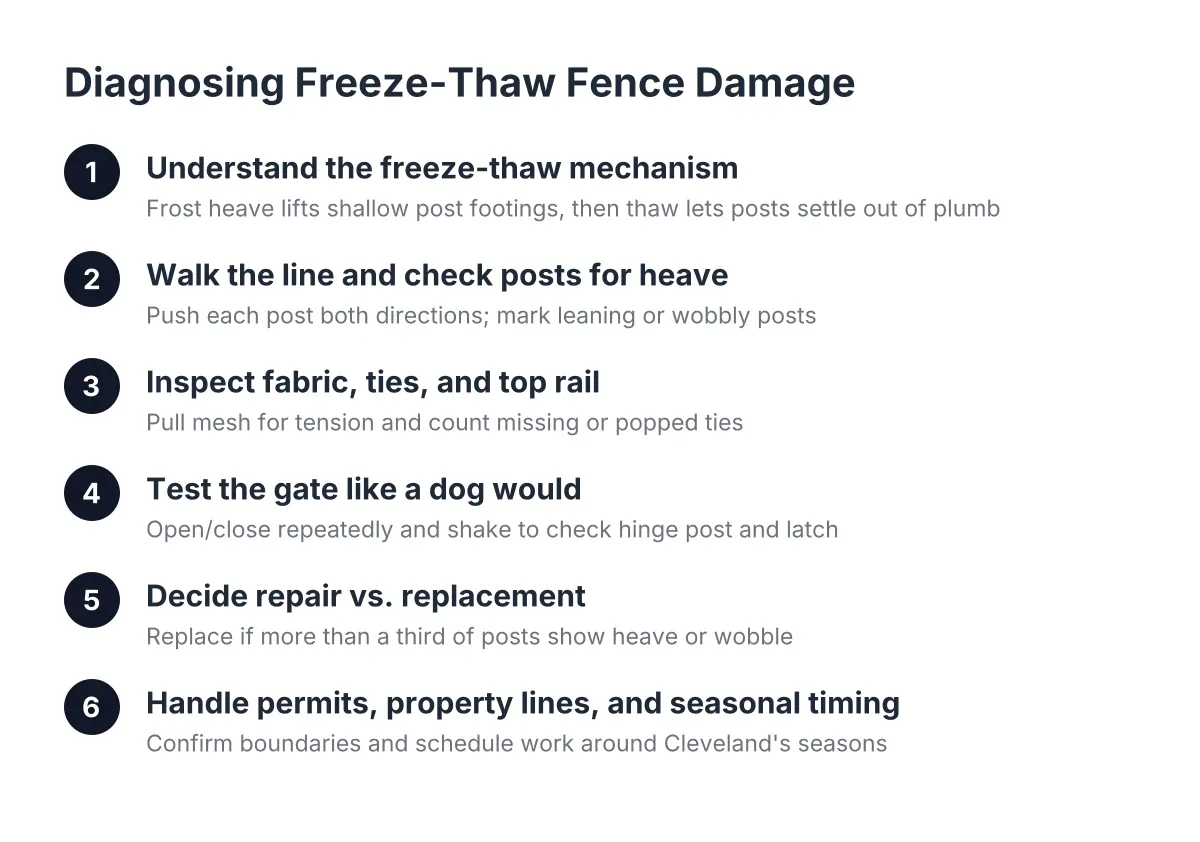
Cleveland's freeze-thaw cycle is the factor no national chain link fence cost calculator accounts for, and it is the one that matters most here. Ground that freezes and thaws repeatedly moves, and it moves fence posts with it. A post set too shallow will heave out of the ground over a few winters, and a heaved post means a leaning fence and a repair bill.
Therefore, posts in Northeast Ohio need to be set below the frost line, in holes deep enough and wide enough that the concrete footing resists heaving. Deeper holes mean more digging, more concrete, and more labor per post than the same fence would need in a milder climate. That shows up in local quotes, and it should. A quote that seems oddly cheap may be cheap because the posts are going in shallow.
Soil matters too. Parts of Greater Cleveland sit on heavy clay that holds water, which makes frost heave worse and digging slower. Rocky fill around older foundations and inner-ring lots adds time. None of this is a reason to panic; it is a reason to expect a local quote to differ from a national per-foot average, and to ask any installer how deep they set posts and why.
Winter also argues in chain link's favor as a material. Galvanized steel does not rot, warp, or pop boards the way wood can after a few harsh seasons. The fabric flexes under snow load instead of cracking. For a low-maintenance perimeter in this climate, chain link holds up with little attention beyond checking gate hardware each spring.
Do You Need a Fence Permit in Cleveland?
Many Cleveland-area projects do require a fence permit, and the rules vary by municipality, fence height, and where the fence sits on the lot. Each suburb sets its own requirements, so the only reliable answer comes from your local building department before any posts go in the ground. Checking first is free; fixing an unpermitted fence is not.
This is the part of the project that keeps first-time buyers up at night, and for good reason. A fence built without a required permit can be flagged, fined, or in a bad case ordered moved or removed. The fix is simple: call your city's building department, describe the fence height and location, and ask what they require. Most departments answer this question all day long.
Property lines deserve the same caution, especially on older inner-ring lots where lot lines run tight and the existing landscape features do not always match the survey. Building even a foot over the line onto a neighbor's property creates a problem no fence company can fix after the fact. If you do not have a recent survey, it is worth knowing exactly where your line is before you commit.
A few questions worth settling before the first phone call:
- Does my city require a fence permit for this height and location?
- Where exactly is my property line, and do I have a survey that shows it?
- Are there corner-lot or front-yard rules that limit height or placement?
- Do I need utility lines marked before digging? (Yes, always, and the marking call is free.)
- Who is responsible for pulling the permit, me or the installer?
That last question matters. A trustworthy installer will raise the permit question themselves, not wave it off to save a trip to city hall. If an estimator never mentions permits, treat that as information about how the rest of the job will go.
Reading a Chain Link Fence Quote Line by Line
Once you understand the cost drivers, a quote becomes easy to audit. Chain link fence cost per foot installed is the headline number, but the line items underneath it tell you what you are actually buying. Here is what a complete quote should spell out:
- Total linear footage and fence height
- Fabric gauge and coating (galvanized or vinyl-coated)
- Post spacing, pipe size, and post depth
- Concrete for every post, not just corners and gates
- Number and size of gates, with hardware
- Removal and haul-away of any old fence, if applicable
- Who handles the permit and the utility locate
For example, suppose a couple who just closed on a new build in a Cleveland suburb needs about 150 feet of 4-foot galvanized chain link with one walk gate to enclose the backyard before their puppy arrives. In that scenario, using the NerdWallet per-foot range of $15 to $25 as a rough national yardstick, the math suggests somewhere around $2,250 to $3,750, with the gate, local post-depth requirements, and site access moving the final number. That is an illustrative estimate, not a quote; the point is that they can now see whether a bid is in a defensible range or needs explaining.
Watch for the gaps. Common surprise charges hide in haul-away of old fencing, extra gate hardware, hand-digging fees, and corner or end posts priced separately from line posts. A low headline number with thin line items often grows on install day. A detailed quote that looks slightly higher on paper is usually the more honest number.
One more thing on cheap bids. The lowest quote often wins the job and loses the decade. A fence built with light-gauge fabric, thin pipe, and shallow posts can need replacement years before a properly built one, which costs more in total than paying for the better build once. Price the fence over its lifespan, not just the install day.
What Chain Link Repair Costs When Something Does Go Wrong
Chain link fence repair is usually cheap relative to replacement, which is another point in the material's favor. HomeAdvisor reports fence repair averages $618, with most homeowners spending between $304 and $948 to restore an existing fence. Angi's 2026 data, based on nearly 3,000 verified projects, puts the national average at the same $618 per project. Those figures cover all fence types; simple chain link fixes often come in below them.
Typical chain link repairs include re-stretching sagging fabric, replacing a bent top rail after a fallen branch, resetting a heaved post, and swapping worn gate hinges or latches. Chain link fence repair contractors handle most of these in a single visit because the system is modular; a damaged section can be cut out and replaced without rebuilding the whole run.
However, there is a point where repair stops making sense. If the fabric is rusted through along the bottom, multiple posts have heaved, or the framework is bent in several places, you are patching a fence that is telling you it is done. A repair that costs a third of a fence replacement, on a fence with a few years left, is money better put toward the new install. An honest assessment from someone who does both repair and replacement is worth getting before you decide.
How to Walk Into the First Call Prepared
The homeowners who get fair prices are the ones who show up to the first conversation already knowing the shape of the project. You do not need to be an expert. You need five pieces of information, most of which you can gather in an afternoon.
- Your footage. Walk the perimeter with a tape measure or pace it off. Even a rough number lets you sanity-check per-foot pricing.
- Your height and purpose. Pet containment, kid safety, and marking a line each point to different heights and gauges.
- Your permit answer. One call to your building department settles whether a fence permit applies to your project.
- Your property line. Find your survey or know that you need one.
- Your gate plan. Decide where you need access and whether anything wider than a person has to pass through.
Armed with that, get two or three written quotes and compare line items, not just totals. Ask each estimator the same questions: post depth, fabric gauge, concrete per post, and who pulls the permit. Experienced chain link fence installers answer those questions without hesitation, because the answers are the job. Vague answers on the basics predict vague workmanship on the fence.
The pattern worth remembering is simple. Chain link fence cost comes down to footage, height, gauge, gates, and how deep your posts have to go to survive a Cleveland winter. The national averages give you a floor for your expectations. Your local building department gives you the permit answer. A detailed quote gives you everything else. Know those three things, and nobody is going to surprise you, not the installer, and not the city.
If you need chain link fence installation, Cleveland Fence Installers can help.
Prefer to talk it through? Call (216) 465-0485 — a quick call is usually the fastest way to get a straight answer for your situation.