Gate Installation Cost in Cleveland: Material and Labor Breakdown
If you just moved into a Cleveland home with no fence and no privacy, the gate is the part of the project most people underestimate. Gate installation cost depends on the width of the opening, the material, the hardware, and how the posts are set, and those four factors swing the price more than most homeowners expect. A basic walk gate on a chain link fence sits at one end of the range. An automatic driveway gate with a motorized operator sits at the other, often costing more than the rest of the fence combined.
This guide breaks down where the money goes: materials, labor, hardware, posts, and the Cleveland-specific details like freeze-thaw ground movement that affect how a gate has to be built here. By the end you should be able to look at an estimate and know what each line covers, and whether the price fits the gate you actually need.
Why Gates Cost More Per Foot Than the Fence Around Them
A gate is the only part of a fence that moves, and moving parts cost more to build and more to install. A fence panel hangs between two posts and never changes. Additionally, a gate swings hundreds of times a year, carries its own weight on hinges, and has to land on a latch in the same spot every time.
That is why a 4-foot gate can cost several times what 4 feet of matching fence costs. The gate needs a rigid frame so it does not sag. It needs heavier posts set deeper, because the hinge post carries the full weight of the gate as a lever. It needs hinges, a latch, and sometimes a drop rod or a self-closing mechanism. Each of those pieces adds material cost and labor time.
For context on the surrounding project, Angi reports that fence installation costs an average of $3,277, with most homeowners paying between $1,860 and $4,843. NerdWallet puts professionally installed fences at $15 to $25 per linear foot on average, citing Angi data, with typical totals between $2,000 and $5,000. The gate is priced on top of that per-foot math, as its own line item, because it is its own small construction project.
Factors That Drive Gate Installation Cost
Gate installation cost comes down to five factors: the width of the opening, the material, the hardware package, the post setting, and whether the gate is manual or automatic. Width and automation move the number the most. A 3-foot walk gate and a 12-foot double driveway gate are different projects, even in the same material.
Gate width and type
Width is the first question any fence company asks. Common configurations, from least to most expensive:
- Walk gate, 3 to 4 feet wide. The standard pedestrian gate. Fits mowers and wheelbarrows at 4 feet. This is the gate most privacy fence projects include.
- Wide walk gate, 5 to 6 feet. Handles riding mowers and larger equipment. Needs a stiffer frame to resist sag across the wider span.
- Double drive gate, 10 to 12 feet. Two leaves that meet in the middle, held by a drop rod. This is the typical manual driveway gate for backyard vehicle access.
- Single driveway gate or sliding gate. One large leaf, usually automated. The heaviest option and the one that demands the most from posts and hardware.
Each step up means more frame material, heavier hinges, bigger posts, and more labor hours. A double drive gate is not twice the cost of a walk gate; it is usually more, because both leaves need their own hinge posts and the leaves must align with each other.
Material: wood, chain link, vinyl, and metal
The gate almost always matches the fence, so material choice is usually settled before the gate conversation starts. Still, the material changes how the gate is built and what it costs.
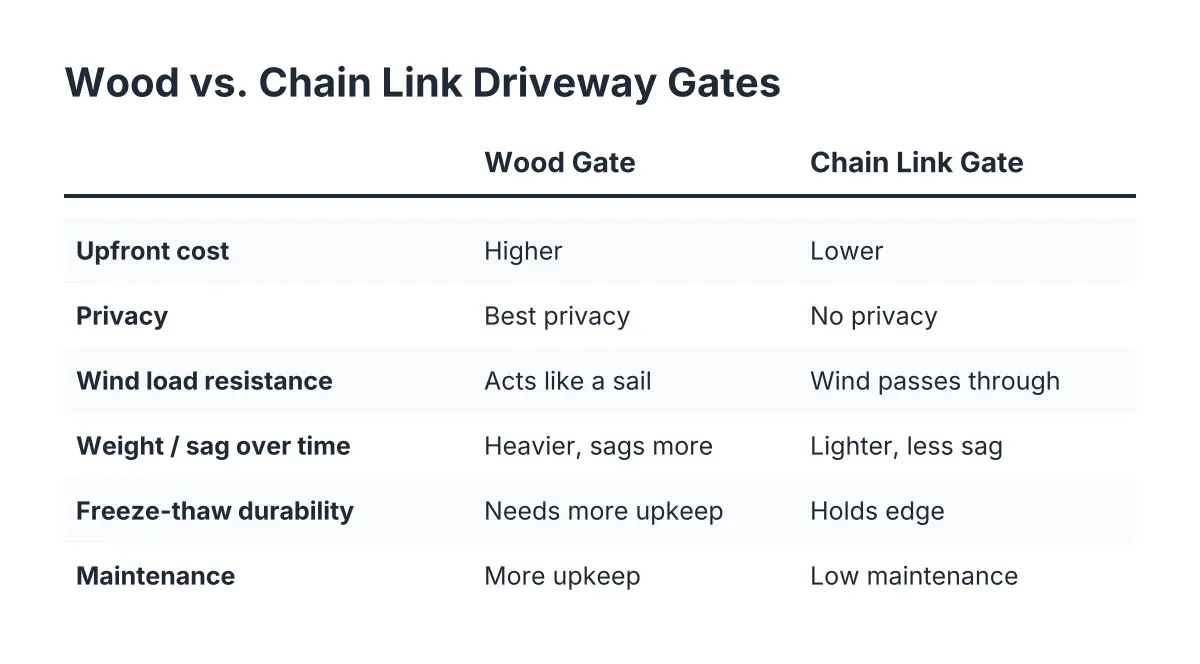
Wood gates on a privacy fence need a real frame, not just pickets screwed to rails. A pressure treated fence gate without diagonal bracing or a steel frame kit will sag within a few seasons, and a sagging gate drags, scrapes, and eventually stops latching. Paying for a framed gate upfront costs less than rebuilding a cheap one later. The same logic applies to fence style: board-on-board and other custom privacy styles use more picket material per foot than a flat-face fence, so a gate built to match costs more too.
Chain link gates are the budget option. The frame is welded or fitted galvanized pipe, the fabric is the same mesh as the fence, and the hardware is simple. For a play-yard enclosure where the goal is containment rather than privacy, a chain link fence with a self-closing gate often delivers the function at the lowest price.
Vinyl gates look clean and never need staining, but the hollow uprights are the weak point. A well-built vinyl gate uses internal reinforcement inside the uprights so the hinge and latch screws have something solid to bite into. Ask any installer quoting vinyl how they reinforce the gate frame; the answer tells you whether the gate will still swing true in five years.
Metal and ornamental aluminum gates cost more upfront but resist sag and weather better than wood. For pool enclosures, aluminum is a common pick because it pairs well with self-closing hinges and holds its shape.
Hardware: the line item that matters for pool and play-yard buyers
Hardware is where safety buyers should slow down and read the estimate. If you are fencing a pool, a trampoline, or a play yard, the gate hardware is usually what the inspector looks at first. Typical requirements in many jurisdictions include self-closing hinges, a self-latching mechanism mounted out of a small child's reach, and a gate that swings away from the pool. Requirements vary by municipality, so confirm the specifics with your local building department before the posts go in.
Standard hardware for a basic walk gate is modest: two or three hinges and a gravity latch. Upgrading to self-closing spring hinges and a magnetic child-safety latch adds real cost, but it is the difference between passing and failing a pool inspection. Lockable latches, keypads, and drop rods for double gates each add their own line.
One build detail worth knowing: good installers set the latch position with ground movement in mind. Cleveland's freeze-thaw cycles shift soil every winter, and a latch striker placed with no margin can stop catching after one season of heave. Mounting the striker with room to stay engaged as the ground moves keeps the gate latching year after year, which matters most when the latch is the thing keeping a toddler out of the pool area.
Posts and footings: where Cleveland winters raise the price
Gate posts do more work than fence posts, and in Northeast Ohio they fight the ground itself. Frost heave can lift or tilt a shallow post, and a tilted hinge post means a gate that drags or will not latch. Proper gate installation here means setting hinge posts below the frost line in concrete, often with a larger-diameter post than the rest of the fence line uses.
That extra digging, concrete, and material shows up in the price. It should. A gate hung on fence-grade posts set shallow is the most common gate failure in this climate. If an estimate for a heavy wood or driveway gate does not mention deeper or heavier gate posts, ask why.
Manual Versus Automatic Driveway Gates: The Cost Gap
An automatic driveway gate costs several times what a manual gate of the same size costs, because you are buying a motorized operator, electrical work, and safety equipment on top of the gate itself. For most Cleveland backyards, a manual double drive gate covers occasional vehicle access at a fraction of the price. Automation earns its cost when the gate gets daily use.
People searching for driveway gate installation near me are usually weighing exactly this choice. Here is what the automatic side adds:
- The operator. A motorized arm or sliding mechanism sized to the gate's weight and length. Heavier gates need stronger, more expensive operators.
- Electrical supply. Power has to reach the gate, which can mean trenching conduit from the house or garage. Solar operators exist but have limits in a Cleveland winter with short, gray days.
- Access controls. Keypads, remotes, phone apps, or intercoms, each its own cost.
- Safety devices. Photo eyes and obstruction sensing that reverse the gate if something is in its path. These are standard on any properly installed automatic gate and matter even more in a household with kids.
- Ongoing maintenance. Operators need periodic service, and road salt and slush are hard on exposed mechanisms.
The honest trade-off: if you open the gate twice a month to mow or park a trailer, automation is money spent on convenience you will rarely use. If you drive through it twice a day, a manual gate becomes the chore you regret. Imagine getting out of the car in sleet to drag a gate open after one Cleveland winter; interest in automatic gate installation near me tends to follow that kind of experience, so think about February before you decide, not July.
A Realistic Cleveland Scenario: Pricing the Whole Project
Suppose a family buys a house in a Cleveland inner-ring suburb with an open backyard, a neighbor's deck looking straight into theirs, and a new above-ground pool going in before summer. Their insurance company and the city both want a compliant enclosure before the pool is used.
In that scenario, the project is a 6-foot wood privacy fence around the backyard with two gates: a 4-foot walk gate at the side yard and a 10-foot double drive gate off the driveway. For the fence portion, Angi data shows privacy fence installation typically runs between $1,800 and $8,000, averaging $4,300, with the final number driven by linear footage, material, and style.
The gates get priced separately, and the estimate for this illustrative project would show the cost drivers clearly. The walk gate carries self-closing hinges and a child-safety latch to satisfy the pool requirement. Furthermore, the double drive gate needs two heavy hinge posts set in concrete below the frost line, a drop rod, and a lockable latch. As a rough illustration, the two gates together could add a four-figure sum to the fence price, with the drive gate making up most of it. That is normal, not padding; the gates are the hardest-working 14 feet of the whole fence.
This scenario also shows why the gate conversation belongs at the start of the project, not the end. Gate locations determine post placement for the entire fence line, and a pool inspection can hinge on which way a gate swings.
Permits, Property Lines, and the Questions New Homeowners Ask
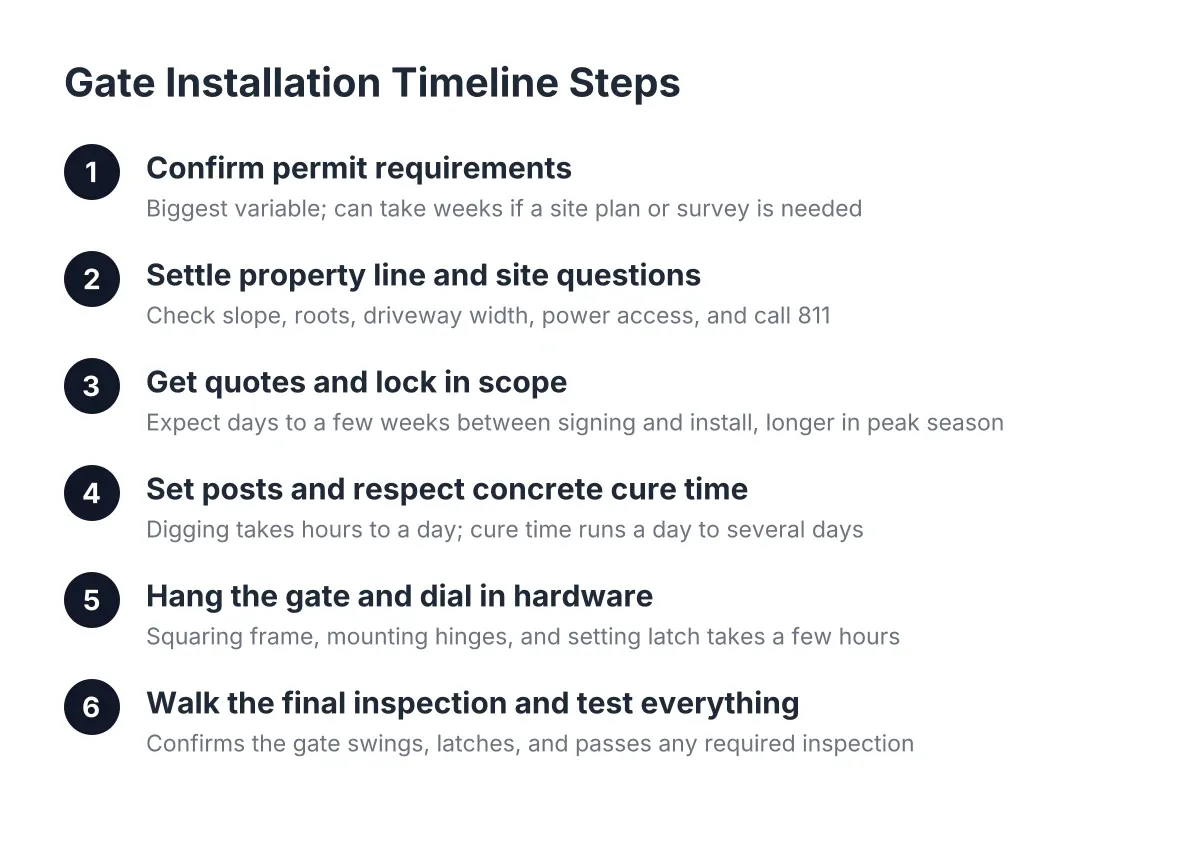
Most Cleveland-area municipalities treat a gate as part of the fence for permit purposes, so the fence permit question covers the gate too. Rules on fence height, placement, and pool enclosures vary from suburb to suburb, and some cities review gate hardware as part of a pool barrier inspection. Do not rely on a neighbor's experience in a different city; verify requirements with your local building department before work starts.
Property lines deserve the same care, especially in older inner-ring neighborhoods where lots are tight and existing landmarks may not match the deed. If you just moved in and do not know exactly where your line runs, find out before anyone digs a post hole. A survey costs far less than moving a fence. Ohio has rules about fences between neighbors, and the details depend on your situation; when the line is uncertain or a neighbor disputes it, that is a moment to consult a surveyor or an attorney rather than guess.
On the common worry that a 6-foot privacy fence will feel like a box: gate and fence style choices can soften the look. A decorative gate, a scalloped or arched top line, or lattice above the pickets keeps the privacy while breaking up the flat wall. Some of those touches, like a scalloped top cut, add labor skill rather than material, which changes how they price.
How to Read a Gate Installation Estimate
Before comparing bids from any fence company, make sure each estimate answers the same questions. A low number that skips the hard parts is not a better price; it is a smaller scope. In 2026, with material prices still moving, line-item clarity matters more than ever.
Check each estimate for:
- Gate dimensions and count. Width, height, and how many gates, stated plainly.
- Frame construction. For wood, whether the gate is braced or steel-framed. For vinyl, how the uprights are reinforced.
- Post spec. Size, depth, and concrete for the hinge posts, and whether they differ from the line posts.
- Hardware list. Hinge type, latch type, and whether self-closing and self-latching hardware is included where a pool or play area requires it.
- Automation scope, if any. Operator model class, electrical work, trenching, and safety devices, each listed.
- Permit responsibility. Who files, and who confirms local requirements with the building department.
The cheapest bid often omits the deeper gate posts, the framed gate, or the compliant latch. Rebuilding a sagging gate or re-hanging one on heaved posts costs more over a few years than paying for the right build once. For reference on what fixes run, HomeAdvisor reports fence repair averages $618, and gate repairs tend to follow similar patterns since the gate is usually the first part of a fence to fail.
The Bottom Line on Gate Costs for Cleveland Homes
Plan the gate as its own project inside the fence project. Width, material, hardware, and posts set the manual gate price; automation multiplies it. In Cleveland, add two local factors to the math: posts deep enough to beat frost heave, and a permit and property-line check before anything is set in concrete.
For the privacy-focused new homeowner, the practical path is a framed walk gate sized for your mower, hardware matched to how the gate will be used, and gate locations decided before the fence layout is final. For the pool or play-yard buyer, spend the extra money on self-closing, self-latching hardware and confirm the requirements with your building department early, because the gate is what the inspection turns on. Get those decisions right and the cost of gate installation stops being a surprise line on the estimate and becomes the most useful money in the whole project.
If you need gate installation, Cleveland Fence Installers can help.
Prefer to talk it through? Call (216) 465-0485 — a quick call is usually the fastest way to get a straight answer for your situation.