Automatic Gate Installation in Cleveland: 8 Things to Know Before You Hire
If you are pricing automatic gate installation in Cleveland, you have probably noticed the same problem most homeowners hit: the top search results are directories and business profiles, not straight answers. You want to know what the work includes, what drives the cost, whether the city needs to sign off, and how to spot a fair quote before you call anyone. This list covers all of it, in plain terms, so you walk into your first phone call already knowing the baseline for automatic gate installation cost.
Here are eight things to sort out before you commit to an automatic or driveway gate project in Greater Cleveland.
1. Know What a Complete Gate Installation Actually Includes
A full gate installation covers more than hanging a panel on hinges. A good installer handles the posts, the gate frame, the hinges and latch, the operator (if automated), and the adjustments that keep the gate swinging true after the ground settles. Anything less and you are buying a callback.
For an automatic driveway gate, the scope typically includes:
- Setting and plumbing the gate posts, usually in concrete, deep enough to resist Cleveland's freeze-thaw ground movement
- Building or hanging the gate itself, squared and pre-racked so it does not sag
- Mounting the operator (swing arm or slide motor) and running power to it
- Installing safety devices such as photo eyes or obstruction sensors
- Programming access: keypad, remote, or phone app
- Testing the latch, the travel, and the auto-close function
Ask any installer to walk you through this list. If they skip the safety sensors or the power run, that cost will show up later as an extra. Trenching for electrical, haul-away of an old gate, and automatic operators are the three most common "surprise" line items, so get them in writing up front.
2. Understand What Drives Automatic Gate Installation Cost in Cleveland
Automatic gate installation cost in Cleveland depends on four main factors: the gate material, the gate width, the operator type, and how far power has to travel from your house to the gate posts. A simple manual walk gate on an existing chain link fence sits at the low end. A wide, automated double swing gate in wood or ornamental metal sits at the high end, often several times the price.
For context on the surrounding fence work, Angi reports that fence installation costs an average of $3,277, with most homeowners paying between $1,860 and $4,843. NerdWallet, citing Angi data, puts professionally installed fencing at $15 to $25 per linear foot on average. A gate adds to that baseline because it concentrates hardware, labor, and adjustment into a few feet of fence line. Automation adds the operator, electrical work, and safety equipment on top. The automatic gate installation cost factors in both the complexity of the hardware and the scope of electrical work required.
The honest answer on exact pricing: nobody can quote your gate without seeing the site. Slope, soil, power access, and gate width all move the number. What you can do is get the quote itemized so you see where the money goes.
3. Sort Out the Permit Question Before You Sign Anything
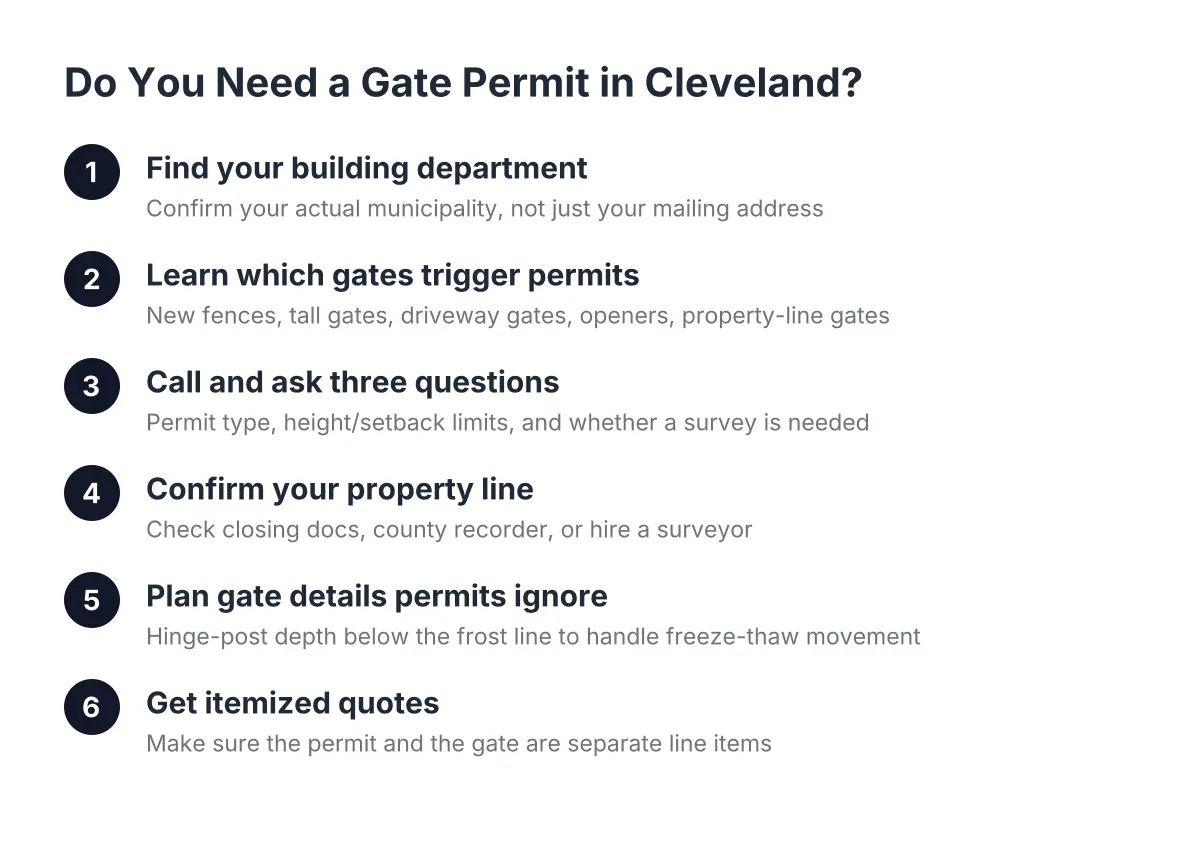
In many Cleveland-area municipalities, a fence or gate project needs a fence permit, and an automated gate can add an electrical permit on top. The rules differ city by city across Greater Cleveland, and the only reliable answer comes from your local building department. Call them, or check their website, before any posts go in the ground.
This matters more than most installers let on. An unpermitted gate can get flagged during a home sale or a pool inspection, and fixing it after the fact costs more than doing it right. A straight-shooting fence company will raise the permit question on the first call, tell you who typically pulls it, and name the municipality's building department as the final word. If an installer waves the question off with "you don't need one," treat that as a red flag, not a convenience.
4. If You Have a Pool or Play Yard, the Gate Is the Code Item
Suppose you put in a pool last fall and your inspector will not sign off until the enclosure meets code. In that scenario, the gate is almost always the sticking point, not the fence. Pool barrier rules in most jurisdictions focus heavily on the gate: it typically must self-close, self-latch, and open away from the pool, with the latch mounted high enough that a small child cannot reach it.
An automatic driveway gate on the same property adds another layer. It needs obstruction sensing so it cannot close on a child or a pet. If you are on an inspection or insurance deadline, tell the installer that on the first call. It changes the hardware list, the latch placement, and sometimes the gate direction, and confirming the exact requirements with your building department before ordering materials saves you a failed inspection.
One practical detail that separates careful installers from fast ones: setting the latch striker with ground movement in mind. Soil in Northeast Ohio shifts with freeze-thaw cycles, and a latch set with no allowance for movement stops catching after a season or two. On a pool gate, a latch that does not catch is a code failure, not a nuisance.
5. Match the Gate Material to Your Fence and Your Winters
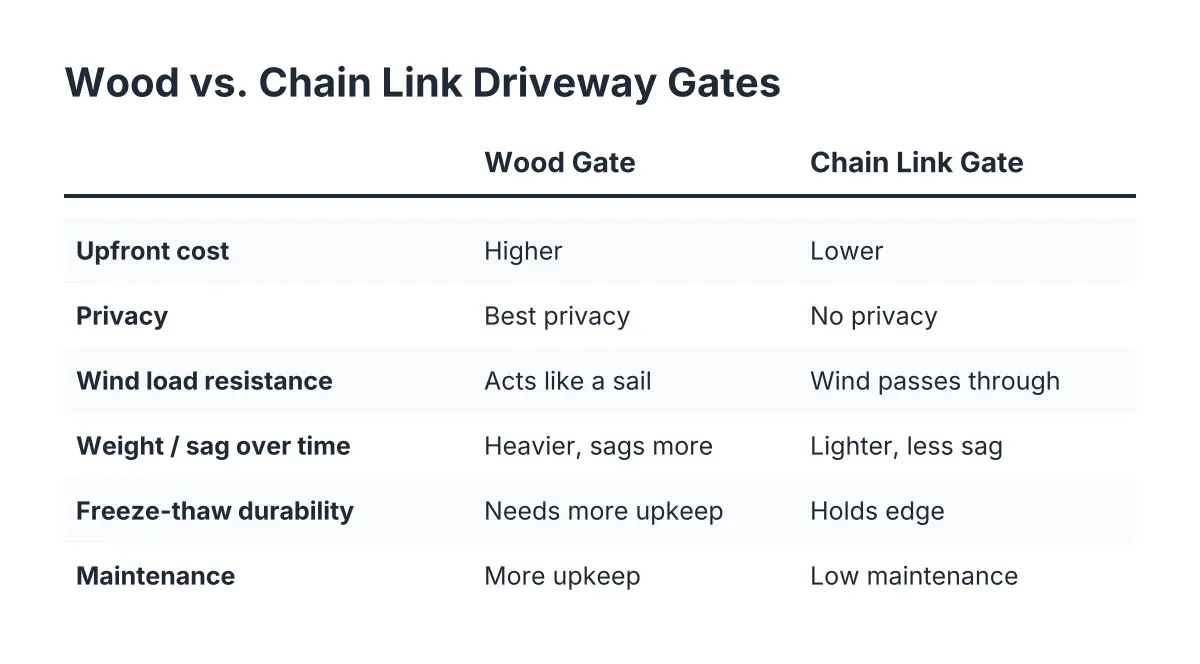
Your gate should match your fence in material and in build quality, because the gate takes more abuse than any panel. A pressure treated fence pairs with a pressure treated wood gate; chain link pairs with a welded-frame chain link gate; vinyl privacy fence pairs with a reinforced vinyl gate. Each has trade-offs worth weighing.
- Wood gates look right on a wood fence but are the heaviest option, so they need diagonal bracing and stout hinge posts to avoid sagging.
- Chain link gates are light, affordable, and hold up well to Cleveland winters, though they offer no privacy.
- Vinyl gates resist rot and never need staining, but the hinge-side framing needs reinforcement, because that is where vinyl gates fail. The latch side rarely rips out; the hinge side does.
- Ornamental metal suits automated driveway gates best, since the frames stay rigid and carry operator hardware cleanly.
For automation, weight matters as much as looks. A heavy wood double gate needs a stronger, pricier operator than an aluminum one of the same width. If budget is the constraint, a lighter gate material can cut both the gate cost and the operator cost at once.
6. Decide What You Can DIY and What Needs a Pro
A homeowner with basic tools can replace a latch, adjust a hinge, or re-stain a wood gate. However, three parts of this work belong with a professional: setting posts, hanging the gate square, and anything electrical. Posts set too shallow heave with the first hard freeze, and a gate hung out of square drags within months. The electrical run for an automatic operator usually requires a licensed electrician, and in most municipalities that work is permitted and inspected.
Call a pro now, rather than later, if you see these warning signs on an existing gate: posts leaning or lifting, a gate that drags or will not latch in winter, hinges pulling out of the post, or an automatic opener that reverses randomly or ignores its sensors. A randomly reversing opener is a safety problem, especially around kids. For reference on repair budgets, HomeAdvisor reports fence repair averages $618, with most homeowners spending between $304 and $948; gate-specific repairs land in a similar neighborhood depending on hardware.
7. Plan Around Cleveland Ground and Cleveland Seasons
Cleveland's freeze-thaw cycles move the ground every winter, and gates show that movement before fences do. A fence panel that shifts a half inch still looks fine. A gate that shifts a half inch stops latching. That is why post depth, concrete footing quality, and smart latch placement matter more here than in milder climates.
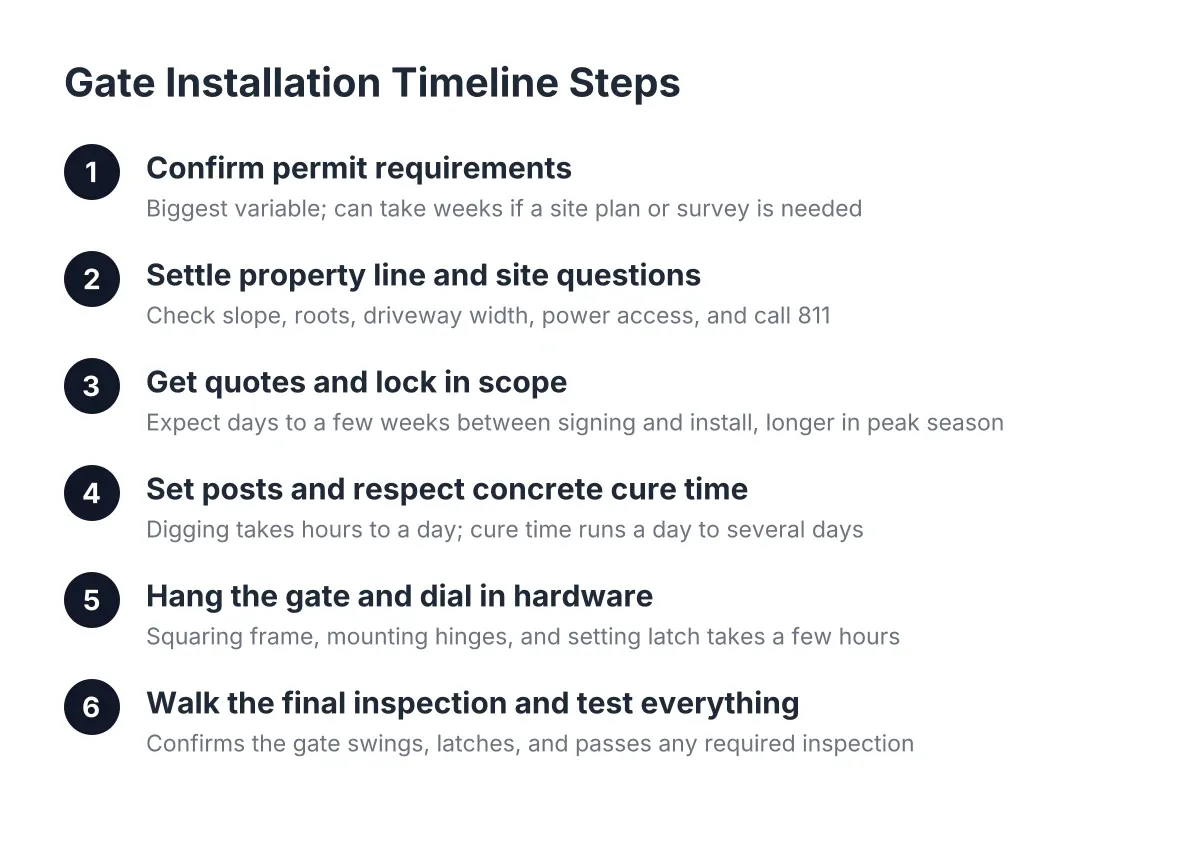
Older inner-ring neighborhoods add a second local wrinkle: tight lot lines. A driveway gate on a narrow lot raises property-line questions fast, and a gate that swings over a shared drive or sidewalk can violate local rules. Before finalizing the design, confirm your property line and check the swing clearance. In addition, think about seasonality: crews can install gates most of the year, but frozen ground slows post setting in deep winter, so homeowners facing a spring pool inspection should not wait until March to start the process.
8. Ask These Three Questions Before You Hire Anyone
Searching "gates installed near me" produces a long list of names and no way to compare them. Three questions cut through it fast.
- Will this project need a permit, and who pulls it? The right answer names your municipality's building department and offers to handle or guide the paperwork, not "you probably don't need one."
- What exactly does the quote include? A fair quote itemizes posts, gate, hardware, operator, electrical, haul-away, and permit handling, so nothing shows up later as an extra.
- How do you set posts for this soil and this climate? You want a specific answer about depth and footing, because post failure is the number one reason gates sag and openers strain.
One caution on comparing bids for automatic gate installation: Cleveland homeowners who pick the cheapest number often pay twice. Pricing differences usually reflect construction quality, hardware grade, and expected lifespan, not just markup. The lowball bid that skips post depth or hinge reinforcement becomes a fence repair or full fence replacement bill years sooner than a solid install.
The Bottom Line on Automatic Gate Installation Costs in Cleveland
An automatic gate project in 2026 comes down to five decisions: material, width, operator, permit, and installer. Settle the permit question with your building department first, get an itemized quote second, and judge installers by how directly they answer the post-setting and safety-sensor questions. If a pool or play-yard inspection is driving your timeline, say so up front; it changes the hardware and the schedule.
Cleveland Fence Installers handles gate installation alongside wood fence, chain link fence, and privacy fence work across Greater Cleveland, and gives straight answers on cost drivers and the permit question before any work starts. If you are ready to compare real numbers for your own driveway or pool enclosure, request a free estimate and bring this list of questions to the call.
If you need gate installation, Cleveland Fence Installers can help.
Prefer to talk it through? Call (216) 465-0485 — a quick call is usually the fastest way to get a straight answer for your situation.