Chain Link vs. Wood vs. Vinyl: Which Fence Suits Cleveland Winters Best?
If you are comparing chain link, wood, and vinyl fencing for a Cleveland property, the winter question matters more than most articles admit. When looking for the best fence for winter, freeze-thaw ground movement, wet springs, and lake-effect snow treat each material differently. This comparison walks through how chain link, wood, and vinyl hold up here, what each costs to install and maintain, and how the fence permit question plays out for each one.
The short version: chain link handles Cleveland winters with the least drama and the lowest cost. Wood looks better and gives you privacy but needs upkeep. Vinyl skips the rot problem but costs more upfront and depends heavily on how well the posts are set. The details below explain why, and which one fits your property and budget.
How Cleveland Winters Stress a Fence
Three things in Northeast Ohio work against any fence: frost heave, moisture, and wind load.
Frost heave is the big one. The ground here freezes and thaws repeatedly through winter. That cycle pushes fence posts up and out of plumb if they are set too shallow or set in concrete that traps water. A fence that was straight in October can lean by March. This affects every material, because every fence is only as good as its posts.
Moisture attacks wood directly. Snow piles against the bottom rail, melts, refreezes, and keeps the lowest boards wet for months. That is where rot starts. Chain link and vinyl do not rot, but moisture still matters for their post footings.
Wind load hits solid fences hardest. A six-foot privacy fence acts like a sail in a January storm off the lake. An open chain link fence lets wind pass through, which puts far less stress on posts and footings. Keep that in mind when you compare chain link, wood, and vinyl on durability; the design matters as much as the material.
Chain Link: The Best Fence for Winter Conditions
Chain link is the most forgiving fence for Cleveland conditions, and the cheapest to install. The open mesh lets wind and drifting snow pass through instead of pushing against the structure. Galvanized steel does not rot, warp, or crack in the cold. If a post does heave, the fabric flexes instead of splitting the way a wood panel can.
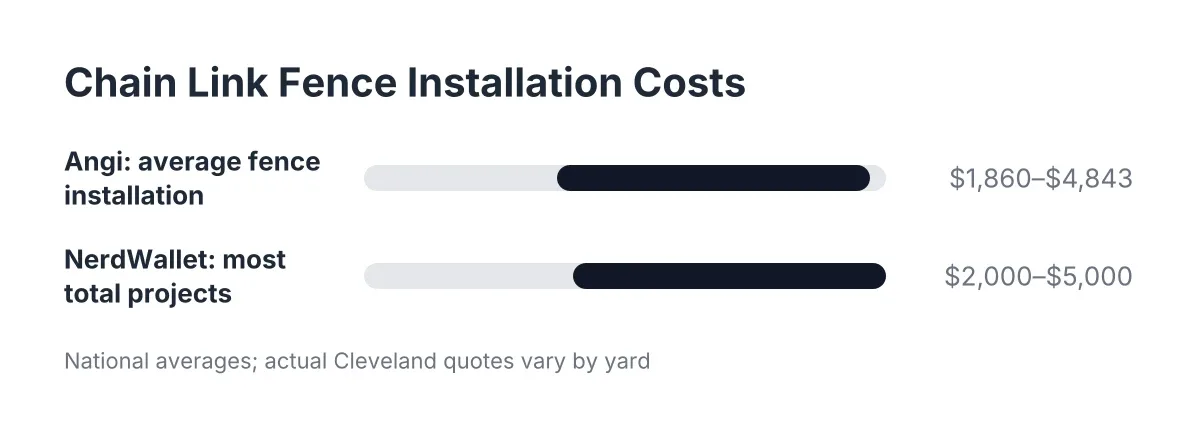
For context on cost, NerdWallet reports professionally installed fences run $15 to $25 per linear foot on average, with total projects typically between $2,000 and $5,000. Chain link usually sits at the low end of that range, which is why it stays the default for rental properties and large yards.
Maintenance is minimal. There are no boards to replace and nothing to stain. Repairs tend to be cheap too; a bent top rail or a torn section of fabric is a small fix, not a rebuild. HomeAdvisor puts average fence repair at $618, and chain link repairs often land below that because the parts are simple.
The trade-offs are honest ones:
- No privacy unless you add slats, and slats add cost and wind load
- A plain galvanized look that some neighborhoods and HOAs restrict
- Vinyl-coated chain link in black or green looks cleaner but costs more than bare galvanized
For a landlord, chain link usually wins on math. Suppose you own a double in Old Brooklyn with a torn-up backyard fence and a tenant moving in next month. In that scenario, a best fence for winter replacement with chain link secures the yard for a dog, satisfies a basic containment need, and costs less than half of what a wood privacy fence would. The yard is rentable again without eating a month of rent.
Wood: Warm Look, Ongoing Work
A pressure treated fence is the standard wood choice here, and for good reason. Untreated wood does not survive Cleveland's wet freeze-thaw cycles at ground level. Pressure treated pine resists rot and insects, which is exactly what the bottom foot of a fence needs when snow sits against it from December through March.
Wood delivers what chain link cannot: full privacy and a traditional look. On Cleveland's older inner-ring streets with tight lot lines, a six-foot wood privacy fence is often what buyers and tenants expect to see between yards.
However, wood asks for ongoing attention in this climate:
- Stain or seal every two to three years, or the boards gray and start absorbing water
- Boards shrink in dry winter cold and swell in wet springs, which loosens fasteners over time
- Gates sag as wood moves with the seasons and need periodic adjustment
- Solid panels catch wind, so posts must be set deep and plumb to survive storms
Cost sits in the middle to upper range. Angi reports that fence installation averages $3,277, with most homeowners paying between $1,860 and $4,843. Privacy fence installation runs higher; Angi data puts it between $1,800 and $8,000, averaging $4,300. A pressure treated privacy fence is usually cheaper than cedar but still a real step up from chain link.
One more point for budget planners: wood repair costs add up over a decade. A snapped picket is cheap, but a rotted post means digging out a footing. If you are quoting out wood, ask the fence company what post setting method they use for frost. Posts set below the frost line are the difference between a fence that lasts and one that leans by its third winter.
Vinyl: Low Maintenance, Higher Buy-In
Vinyl fencing solves wood's biggest Cleveland problem. It does not rot, and it does not need staining. Snow can sit against a vinyl privacy fence all winter without starting decay. The color will not gray out the way unstained wood does, though vinyl is still PVC and will burn under extreme heat.
The catch is that vinyl is a system, and the posts are its foundation. The panels have no structural strength of their own; they rely entirely on properly set posts. In freeze-thaw ground, a heaved vinyl post telegraphs through the whole panel run. Good installers handle tricky spots, like tight corners or runs near trees, by reinforcing posts with a metal pipe inside the vinyl sleeve. That detail matters more here than in milder climates, so choosing the best fence for winter in vinyl requires attention to post installation.
Cold also changes how vinyl behaves. PVC gets brittle in deep cold, so a snowblower discharge or an impact in January can crack a panel that would flex in July. Replacement panels are usually available, but matching an older color can take effort.
On cost, vinyl runs higher upfront than both chain link and wood. The chain link vs vinyl fence cost gap is the widest comparison on this page; you might pay double or more per foot for vinyl over galvanized chain link. The argument for vinyl is the long game: no staining, no rot, and fewer repairs if the posts were set right.
For a landlord comparing chain link, wood, and vinyl across several rentals, vinyl rarely pencils out unless the property competes at a higher rent tier where curb appeal moves the number.
Chain Link, Wood, and Vinyl Side by Side
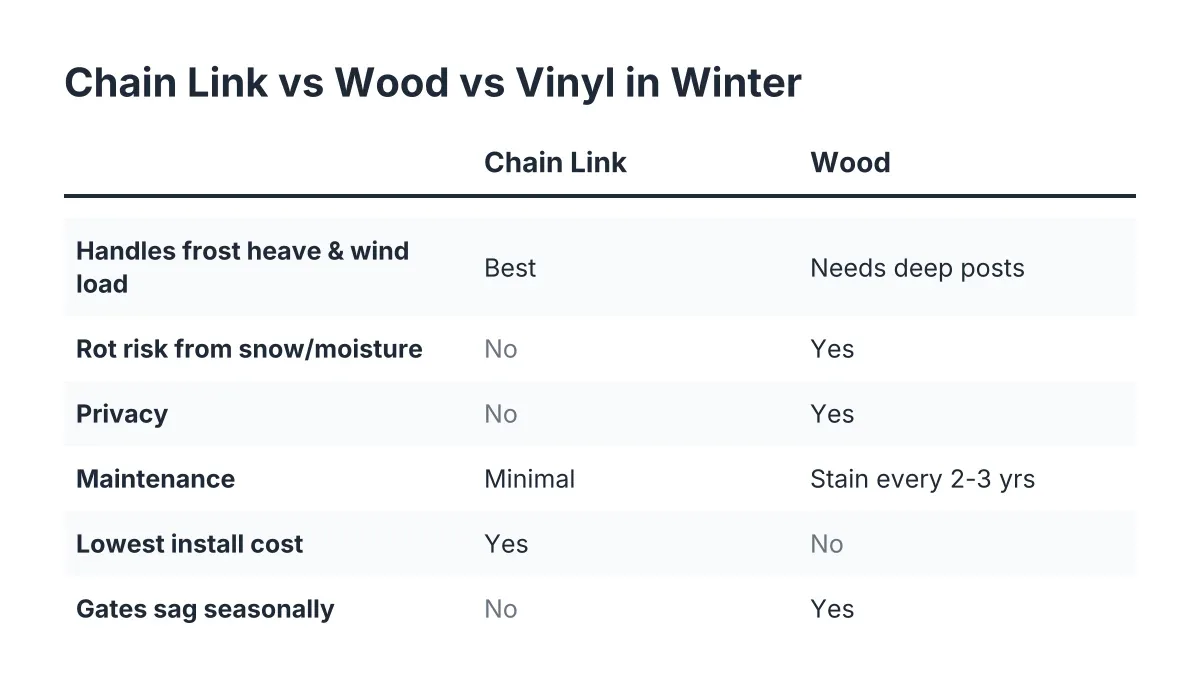
Here is the winter-focused comparison in one place:
- Frost heave resistance: Chain link is most forgiving; wood and vinyl both show post movement in the panels, and vinyl shows it most
- Wind load: Chain link passes wind through; solid wood and vinyl privacy panels take the full force
- Moisture and rot: Chain link and vinyl do not rot; pressure treated wood resists rot but needs sealing
- Winter impact damage: Chain link flexes; wood dents or cracks a board; cold vinyl can crack a panel
- Upfront cost: Chain link lowest, pressure treated wood middle, vinyl highest
- Ongoing maintenance: Vinyl lowest, chain link low, wood highest
- Privacy: Wood and vinyl full privacy; chain link only with added slats
One related question comes up often: can you convert a chain link fence to wood? Usually not by reusing the framework. Chain link posts are round steel pipe spaced for mesh, not for wood panels, and they are rarely set to carry the wind load of a solid fence. A conversion is really a fence replacement, so budget it that way.
Permits and Property Lines: Settle This Before Any Material
Do you need a fence permit in the Cleveland area? In many Greater Cleveland communities, yes, and the rules differ by suburb. Height limits, setback rules, and which side of the fence must face the neighbor all vary from one building department to the next. The material you choose can matter too; some suburbs restrict chain link in front yards or cap privacy fence height.
This is where first-time fence buyers get burned. The fence itself is fine, but it sits six inches over the property line or stands a foot taller than the local limit, and now there is a violation notice. On older inner-ring streets with tight lots, the property line question is not academic. A survey or a careful check of your plat map is cheap compared to moving a fence.
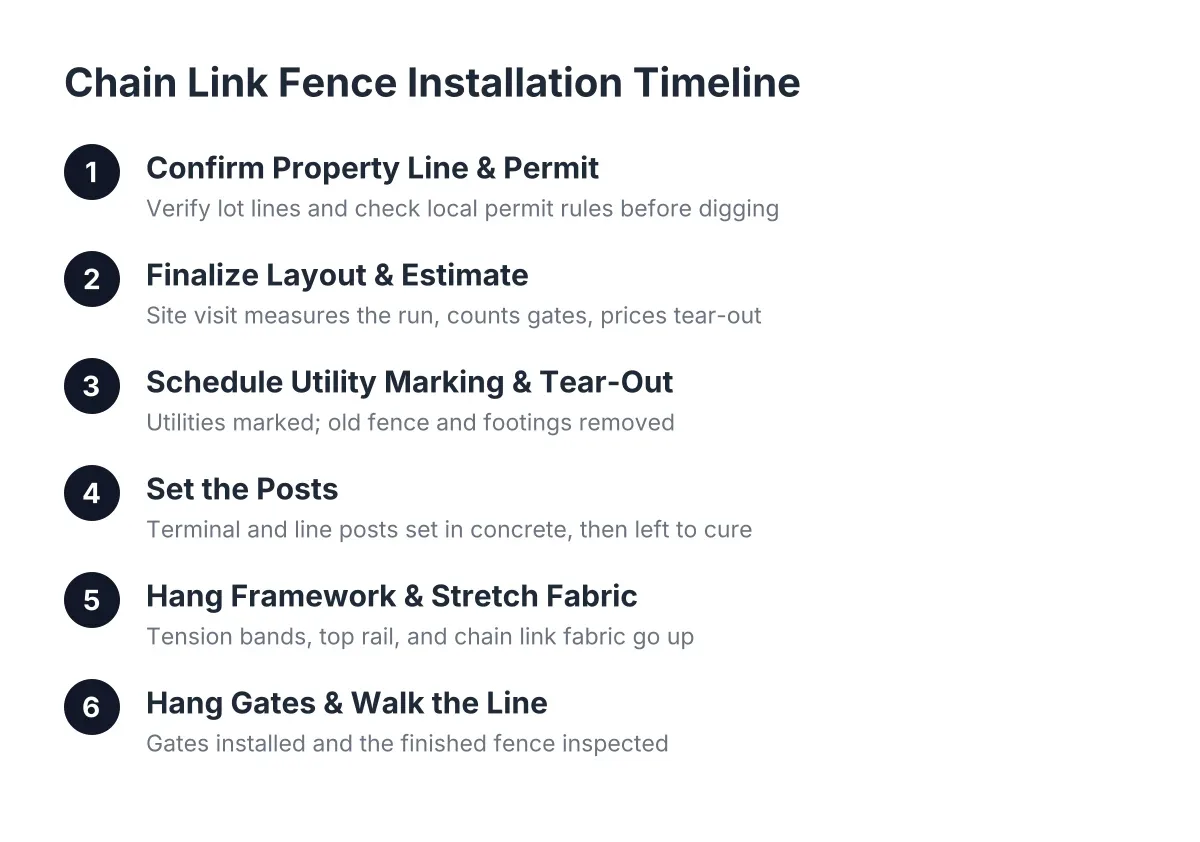
Therefore, before you sign anything, do these three things:
- Call your city or suburb's building department and ask whether a fence permit is required for your height, material, and location on the lot
- Confirm your property line; do not trust an old fence line or a neighbor's memory
- Ask any installer you talk to who pulls the permit, you or them, and get that answer in writing on the estimate
A quote that skips the permit question is not a cheaper quote. It is a quote that leaves the risk on you. Do not rely on this article for your suburb's specific rules; verify with your local building department, because requirements and fees change.
Getting Honest Quotes on Any of the Three
Whatever material you land on, the quote process is where budget worriers protect themselves. Get the estimate itemized so you can see what drives the number. A fair quote for chain link, wood, or vinyl should break out:
- Linear footage and fence height
- Material grade (gauge and coating for chain link, pressure treated vs. cedar for wood, panel style for vinyl)
- Number of gates; gate installation is almost always a separate line item
- Tear-out and haul-away of the old fence, if this is a fence replacement
- Post setting method and depth, which matters most for frost
- Who handles the permit
When you talk to chain link fence installers specifically, ask about fabric gauge, framework pipe diameter, and whether the price covers a bottom tension wire. Thinner fabric and lighter pipe are how a low bid gets low. The same logic applies to wood and vinyl; the cheap quote usually hides in the materials, not the labor.
As a rough sanity check, compare any bid against the national figures above. A quote wildly below the typical range means something is missing. A quote wildly above it deserves a line-by-line explanation. If a slope, a drainage issue, or a disputed line complicates your lot, bring in a professional to look at the site before you commit; some problems are not visible in a phone estimate.
How to Choose
Match the fence to the job, not to the brochure.
Choose chain link if budget, speed, and winter durability lead your list. It is the practical pick for rental properties, dog containment, and large yards, and it shrugs off frost heave better than anything solid.
Choose a pressure treated wood fence if privacy and looks matter and you will keep up with staining. It fits older Cleveland neighborhoods and adds the kind of backyard tenants and buyers notice.
Choose vinyl if you want privacy without maintenance and the upfront cost fits your budget. Just make post setting the first question you ask, because in freeze-thaw ground the posts decide whether vinyl was worth the premium.
For most Cleveland properties, the decision comes down to one question: do you need privacy? If no, chain link is hard to beat here. If yes, weigh wood's upkeep against vinyl's price, and make sure whoever installs it sets the posts for a Cleveland winter, not a catalog photo.
If you need chain link fence installation, Cleveland Fence Installers can help.
Prefer to talk it through? Call (216) 465-0485 — a quick call is usually the fastest way to get a straight answer for your situation.