Privacy Fence Installation on Tight Cleveland Lots: Setbacks and Neighbor Rules
If you just moved into a Cleveland house with an open backyard, you can probably see straight into your neighbor's kitchen, and they can see into yours. A privacy fence installation fixes that, but on Cleveland's tighter lots, the fence itself is the easy part. The hard part is knowing where your property line sits, whether you need a fence permit, and how to avoid a dispute with a neighbor you just met. This guide walks through the process step by step, written for the lots we actually build on: older inner-ring streets, narrow side yards, and ground that moves every winter.
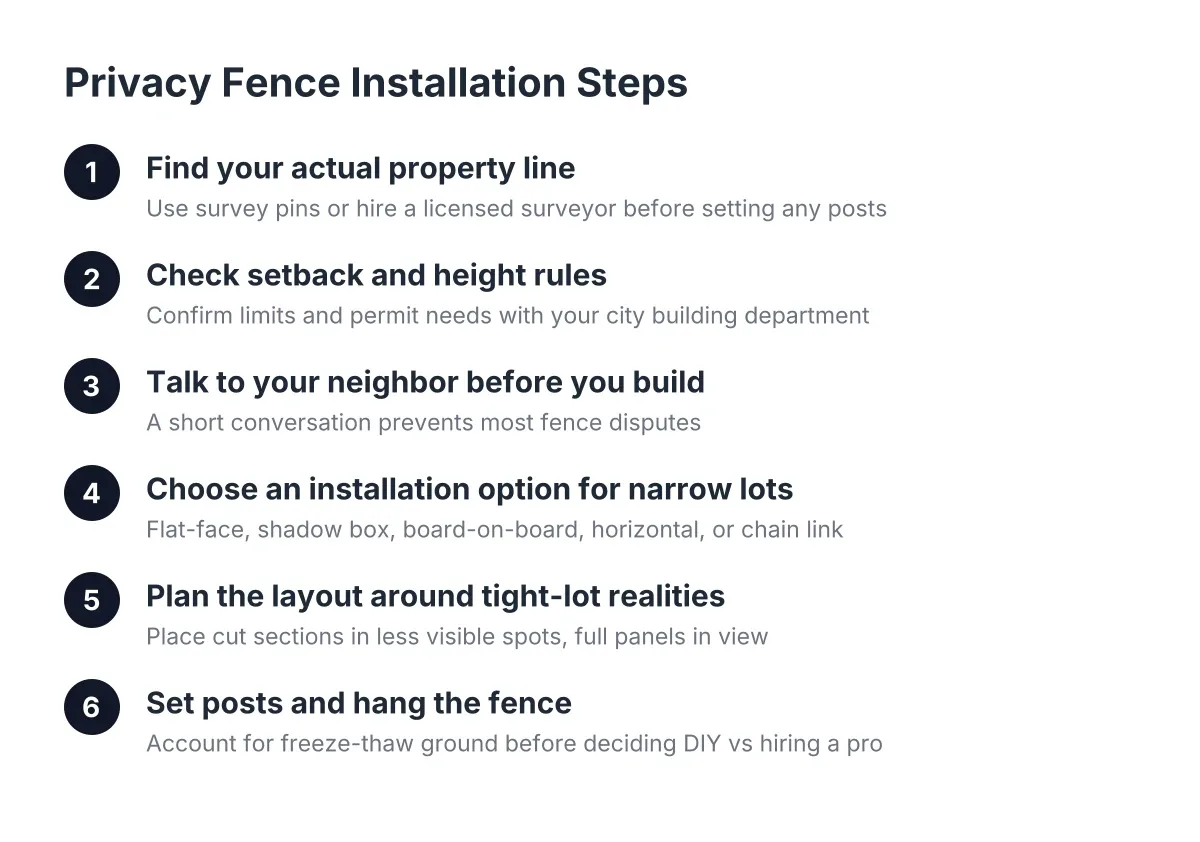
Follow these steps in order. Each one prevents a specific, expensive problem later.
Step 1: Find Your Actual Property Line Before Anything Else
Do not guess the line from the old chain link fence next door or a row of hedges. On older Cleveland lots, existing fences are often inches or even feet off the true boundary. If you set posts on your neighbor's land, you may have to tear the fence out and rebuild it at your own cost.
Start with the documents you already have. Your closing paperwork may include a survey or a mortgage location drawing. County GIS maps can show the general shape of your parcel, but they are not accurate enough to build from.
If you cannot find survey pins at the corners of your lot, hire a licensed surveyor to mark the line. On a tight lot where houses sit 10 to 15 feet apart, a few inches matter. A survey is a few hundred dollars. Rebuilding 150 feet of fence is thousands.
This step matters most for the exact situation new homeowners worry about: you do not want your first conversation with a neighbor to be about a fence built on their side of the line.
Step 2: Check Setback and Height Rules With Your City
Cleveland and each suburb set their own fence rules, and they differ more than most people expect. Before you price materials, call or visit your local building department and ask three questions:
- How tall can a fence be in the back yard, the side yard, and the front yard?
- Does a fence have to be set back from the property line, the sidewalk, or the street corner?
- Is a fence permit required for this project, and what does the application need?
Many communities cap backyard privacy fences at 6 feet and limit front yard fences to 3 or 4 feet. Corner lots often have sight-triangle rules near the intersection so drivers can see. Some cities require the finished side of the fence to face outward, toward the neighbor or street.
Do not rely on what a forum or a friend in another suburb says. A rule that applies in Parma may not apply in Cleveland Heights. Verify the current requirements with your own building department, in writing if you can, since rules change and 2026 requirements may differ from what a previous owner dealt with.
If you have a pool, a trampoline, or young kids, this step carries extra weight. Pool barrier rules often set a minimum fence height, limit gaps under and through the fence, and require self-closing, self-latching gates. An inspector or insurance company may need the enclosure finished before they sign off, so confirm those specs before you order anything.
Step 3: Talk to Your Neighbor Before You Build
Ohio does not generally force a neighbor to split the cost of a residential fence you choose to build on your own property, though shared-fence situations can get legally complicated. You do not usually need their permission to build on your side of the line. Even so, a five-minute conversation prevents most fence disputes.
Tell them what you are planning: a 6-foot wood privacy fence, set on your side of the surveyed line. Show them where the pins are. Ask if they have any concerns about access during construction, since on a tight lot the crew may need to work close to their side.
This conversation also settles the "boxed-in" worry many new homeowners have. A shadow box style, where pickets alternate on both sides of the rails, looks identical from both yards. That makes it an easy sell to a neighbor who does not want to stare at framing. A standard flat privacy fence has a finished side and a rail side, and convention, plus some local codes, puts the finished side facing out.
If a boundary is genuinely contested, or an existing fence straddles the line, stop and get legal advice before building. That is a property dispute, not a fencing project.
Step 4: Privacy Fence Installation Options for Narrow Lots
Style affects cost, looks, and how the fence reads from the street. The main options for residential privacy fencing:
- Standard flat-face wood privacy fence. Pickets butted edge to edge on one side of the rails. The most affordable full-privacy option and the baseline most quotes are built on.
- Shadow box. Pickets alternate on each side of the rails. Both neighbors see the same finished look, and air moves through it, but it costs more because it uses more picket material for the same length.
- Board-on-board. Overlapping pickets that stay private even as wood shrinks. More material and more labor than flat-face, so expect a higher price per foot.
- Horizontal designs. Modern look, but splice points where boards meet need vertical trim strips, which adds labor.
- Chain link with privacy slats. The budget route. Less visual privacy than wood, but durable and lower cost.
Pressure treated pine is the workhorse for wood privacy fences in Northeast Ohio; cedar costs more and weathers to gray. If the fence line mixes full panels and cut sections, a good installer puts the cut sections in the least visible spots and saves full panels for the parts of the yard you see every day. At a corner where a full panel will not fit, the crew cuts a section to size and adds a picket to hide the cut edge. Details like that separate a clean install from one that looks pieced together.
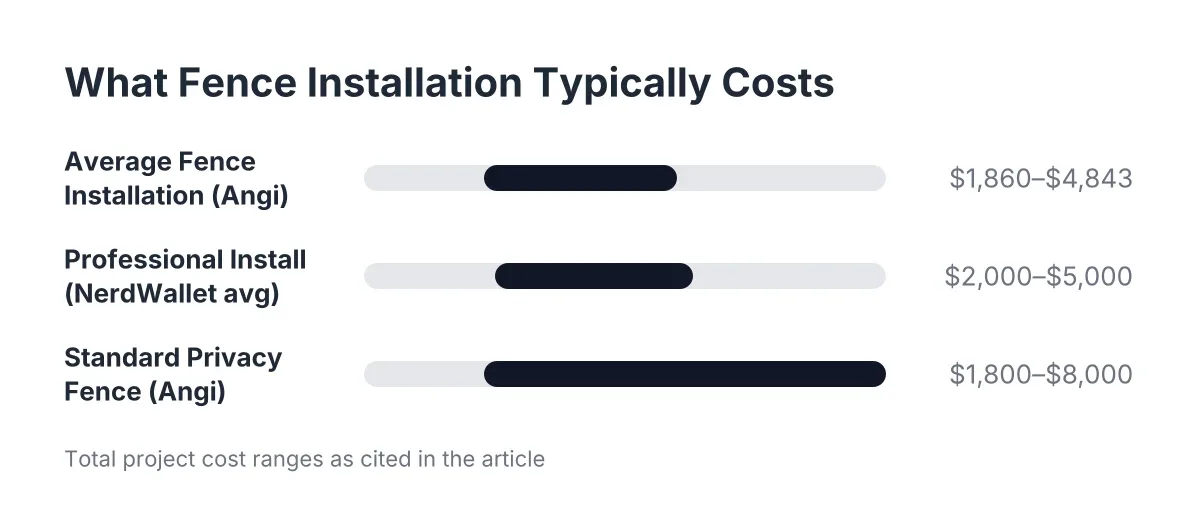
For budgeting, Angi data shows privacy fence installation typically runs between $1,800 and $8,000, averaging $4,300. Custom styles like board-on-board sit at the high end because they genuinely take more boards and more hours, not because of markup.
Step 5: Plan the Layout Around Tight-Lot Realities
Measure the fence line and sketch it. Mark gate locations; a 4-foot walk gate handles a mower, and a wider double gate matters if you ever need vehicle or equipment access to the back yard. On narrow side yards between houses, confirm the gate swing clears utility meters, downspouts, and AC units.
Next, call 811 before anyone digs. Utility locating is free and required, and on older Cleveland streets the lines do not always run where you expect.
Account for slope. Cleveland lots often pitch toward the street or an alley. The crew will either rack the fence to follow the grade or step the panels, which leaves triangular gaps at the bottom. If you have a dog or small kids, decide how those gaps get handled before the posts go in.
Step 6: Set Posts for Freeze-Thaw Ground, Then Hang the Fence
Post setting is where Cleveland fences live or die. Frost heave from freeze-thaw cycles pushes shallow posts up and out of plumb within a few winters. Posts need to be set below the local frost depth in concrete, with the concrete crowned so water sheds away from the wood instead of pooling around it.
From the finished side, posts should hide behind the panels; from your yard side, a post running a few inches above the top rail reads as intentional and neat. Once posts cure, rails and pickets go up fast. A decorative touch like a scalloped top can be cut into a standard fence later with a flexible guide and a circular saw, which adds labor skill but no extra material.
For example, suppose a homeowner in Old Brooklyn buys a house on a 40-foot-wide lot with no fence at all. The survey shows the neighbor's driveway sits 18 inches from the line. In that scenario, the fence gets set a few inches inside the line on the owner's side, posts go below frost depth, the finished face points toward the driveway, and the one cut panel lands behind the garage where nobody sees it. That is a normal week of work for a residential crew, not a special project.
Step 7: Decide Whether to DIY or Hire a Fence Company
DIY work on fence installation saves labor cost, and labor is a large share of any quote. However, on a tight lot the risk profile changes. A fence set on the wrong side of the line, built over the height limit, or installed without a required permit can trigger an order to remove it. Digging 30 or more post holes to frost depth in clay is also brutal work.
Hiring makes more sense when any of these apply:
- Your property line is uncertain or the lot is narrow
- Your city requires a fence permit and inspections
- You need pool or play-yard code compliance before a hard inspection date
- The run is long, sloped, or includes multiple gates
When you compare residential fencing companies, ask each one who pulls the permit, how deep they set posts, and how they handle cut panels and slopes. A fence company that gives straight answers on permits and post depth is telling you how the rest of the job will go. Most will walk the line with you and give a free estimate; use that visit to ask the setback questions from Step 2. This applies to any fence installation, whether it is new construction or fence replacement along an existing line. If you are replacing a leaning fence instead of starting from bare ground, the same permit and property-line questions apply, and fence replacements often uncover old posts set on the wrong side of the line.
Quick Answers on Cleveland Privacy Fences
How close to the property line can a privacy fence go?
Setback rules for a privacy fence vary by city in Greater Cleveland. Some communities allow a fence directly on the line, while others require it to sit entirely on your property, sometimes with a small setback. Confirm the rule with your local building department before setting posts, and always build from a surveyed line, not a guess.
Does my neighbor have to pay for half the fence?
In most Ohio residential situations, a neighbor does not have to split the cost of a privacy fence you choose to build on your own property. Cost-sharing generally only comes into play with true shared boundary fences or a voluntary agreement. If you want them to contribute, get any agreement in writing before work starts.
Do I need a permit for privacy fence installation?
Many Greater Cleveland communities require a fence permit for installing a privacy fence, and requirements differ by city. The application usually asks for a site plan showing the fence location, height, and materials. Do not treat permit rules from one suburb as valid in another; verify with your own building department before work begins.
A privacy fence on a tight lot is a solvable problem. Survey first, check the rules, talk to the neighbor, and set the posts for Cleveland winters. Do those four things and the fence will mark your boundary cleanly for decades instead of becoming the first argument on your new street.
If you need privacy fence installation, Cleveland Fence Installers can help.
Prefer to talk it through? Call (216) 465-0485 — a quick call is usually the fastest way to get a straight answer for your situation.